



Description
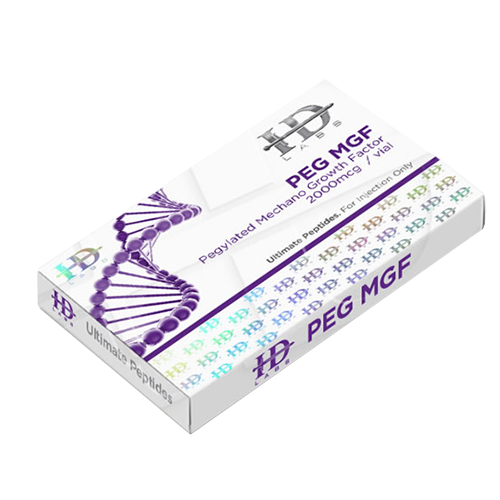
What Is HD Labs PEG MGF?
HD Labs PEG MGF (Mechano Growth Factor) is a synthetic splice variant of the Insulin-Like Growth Factor-1 (IGF-1) gene, also known as IGF-1Ec in humans. Naturally, this variant is produced by muscle tissue in response to overload, stress, or injury, where it plays a key role in muscle repair and regeneration.
MGF helps activate satellite cells — specialized stem cells responsible for repairing damaged muscle fibers and promoting new tissue growth. This makes it a vital component in the body’s adaptive response to exercise and physical stress.
The PEGylated form of MGF (PEG MGF) has been developed to enhance its stability and bioavailability. PEGylation involves attaching a polyethylene glycol (PEG) molecule to the peptide, allowing it to circulate longer in the bloodstream and maintain effectiveness over time.
How PEG MGF Works
When mechanical stress or muscle damage occurs — for example, during resistance training — the body naturally releases Mechano Growth Factor as part of the repair process. This local release stimulates muscle satellite cells to proliferate and fuse with damaged muscle fiber. Thus supporting the regeneration of new, stronger tissue.
Synthetic PEG MGF mimics this process. When introduced into the body, it triggers a similar cascade of events that can enhance muscle cell activation, protein synthesis, and tissue repair.
One of the most important distinctions between MGF and traditional IGF-1 is that MGF acts locally at the muscle site, while IGF-1 has more systemic effects. This localized action allows MGF to support targeted recovery and muscle adaptation.
By attaching a PEG molecule, PEG MGF gains improved circulation time and stability, enabling longer activity within the body and less frequent administration in clinical or research contexts.
Potential Benefits of HD Labs PEG MGF
Research on MGF and PEGylated variants has identified several physiological effects that may contribute to enhanced recovery and muscle performance. Reported benefits include:
-
Accelerated muscle repair and recovery after training or injury
-
Increased muscle fiber growth through satellite cell activation
-
Reduction of fat mass and improved body composition
-
Enhanced endurance and physical resilience
-
Support for bone and connective tissue strength
-
Improved lipid profile and possible cholesterol regulation
-
Potential neuroprotective properties aiding nerve recovery
Because MGF expression naturally declines with age, maintaining proper levels may also help combat age-related muscle loss (sarcopenia) and support overall functional strength.
HD Labs PEG MGF in the Body’s Regeneration Process
After physical exertion or injury, the IGF-1 gene produces different splice variants, including MGF. This early response initiates muscle regeneration by stimulating new cell growth. Once the repair process begins, the body shifts to producing IGF-1Ea, which further supports protein synthesis and long-term recovery.
The coordinated timing of these two forms — MGF first for repair, IGF-1 later for growth. It represents the body’s natural adaptation sequence. PEG MGF may help replicate or enhance this cycle by maintaining a longer duration of MGF activity.
Studies also indicate that MGF may contribute to heart muscle recovery and nerve protection. Following damage, suggesting a broader role in cellular repair and regeneration.
Medical and Scientific Insights
Scientific research has shown that MGF operates partly through an IGF-1 receptor–independent pathway. This differentiates its mechanism from that of IGF-1 itself. It activates intracellular signals such as ERK1/2 rather than Akt phosphorylation, influencing cell proliferation and regeneration without directly mimicking insulin-like activity.
Experimental findings in rodent and human models have shown increased MGF expression following muscle overload, injury, and cardiac stress, highlighting its function as a repair signal peptide. PEGylated variants allow for longer-lasting effects, making them more viable for medical and therapeutic investigation.
The compound’s pharmacokinetics, safety, and optimal dosing are still being studied in clinical and preclinical settings.
Important Notes on Use and Research Context
In laboratory and research discussions, PEG MGF has been evaluated at intermittent injection frequencies (e.g., two to three times per week) to maintain consistent activity. However, these studies are experimental and not intended for unsupervised application.
Authentic PEG MGF formulations, such as those by HD Labs, are designed to mirror natural MGF’s molecular sequence and stability.
Conclusion
PEG MGF (Mechano Growth Factor) is a PEGylated splice variant of IGF-1 that plays a vital role in muscle regeneration, recovery, and repair. By promoting satellite cell activation and localized tissue growth, it represents one of the most fascinating peptides in muscle biology.
Its potential benefits include enhanced muscle recovery, improved body composition, and support against age-related muscle decline, though research is ongoing.
PEG MGF should be regarded as a scientific and medical research compound, not a general-use supplement. Its effects, benefits, and safety should always be evaluated in medically supervised environments.


Reviews
There are no reviews yet.